


Path to Progress: Press Release

Important Dates:
· Opening Reception: Tuesday, October 20th, 2026, 2- 5pm
· Artist Talk: Thursday, October 22nd, 2026, 11am - 12 noon
Artist Statement:
“I grew up admiring artworks that could be found in the daily newspapers such as editorial cartoons and comic strips. The idea of artists documenting history and inventing history inside their own created worlds appealed to my desire to invent characters and environments. These strips and cartoons introduced me to symbols and icons that stood for larger ideas that often reflected on the daily events and commonality of life. I thought of my favorite characters as representatives of different viewpoints that I may not have access to in real life. There was a viewpoint that was missing from the strips. That same voice was also absent in the fine art world and media like movies and television shows. Artist of color who worked figuratively were given platforms for expression, but their viewpoints were always depicted rooted from the perspective of the past or immediate present. I saw a lack of people of color protagonist or main character leads who explored futuristic worlds and navigated universes heavily reliant on science fiction and creative invention. The system strongly favored ideas along racial lines and lines of heritage in regard to artists of color. The viewpoints represented in major forums for art encouraged actuality and realism as an unspoken rule.
As I read more about Afrofuturism, I began to understand the importance of representation, and I questioned how people of color were portrayed across many different genres. I reached an understanding that to be powerful and prosperous in the future you must first imagine yourself with the power you want to possess. My artistic career always leaned towards world building, so I began writing and drawing in a focused way. Forget Me Nots Land was born on the back of American tales mixed with African folklore placed in an otherworldly setting.
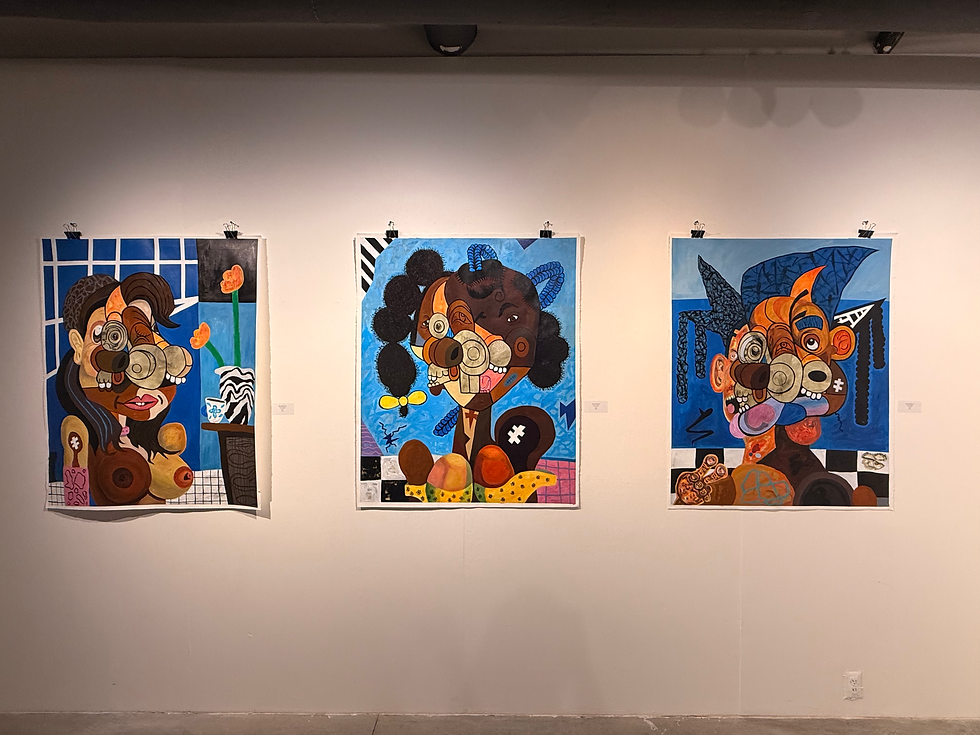
I think of Forget Me Nots Land as a multiverse that runs in tandem with this contemporary era. I use my solo exhibitions to explore chapters from the Forget Me Nots Land story. This story mostly follows my protagonist, Bookie, a preteen Black American youth. The exhibitions are usually a mix of paintings, drawings, sculpture, and animation. Like the writers of my favorite comic strips, I use real life events to glean ideas that are important for today’s conversations. I transpose those ideas through figurative abstraction and iconography. Art historical references, specifically; Modernist and the Post-Modern era motifs, often make their way into my artworks when they provide pertinent talking points of discussion. I relate figurative abstraction to editorial cartoons as they are both highly personal and intelligently symbolic. The narrative for my created world grows daily. The writing and drawing process work together in tandem. I hope Forget Me Nots Land serves the same purpose for others that the daily comics provided me- a place for curiosity, exploration, and adventure.”



- Roger Allan Cleaves
Curatorial statement
Path to Progress represents chapters in Roger Allan Cleaves’s ongoing narrative universe, Forget Me Nots Land—a world where history, folklore, popular culture, and imagined futures come together. Originally from Memphis, Tennessee, Cleaves brings a perspective shaped outside the Pacific Northwest to Archer Gallery. He will join us for the exhibition opening and an artist talk, giving students and visitors an opportunity to hear directly about the ideas, stories, and visual references behind his work. Cleaves’s practice is deeply connected to Afrofuturism, a movement that brings together Black history, African traditions, fantasy, technology, and science fiction to imagine new possibilities for the future. Afrofuturist art matters because imagination can be a form of agency. By envisioning Black people as protagonists, explorers, inventors, and creators of future worlds, artists can challenge histories of exclusion and imagine futures in which Black life can thrive. This idea is at the heart of Forget Me Nots Land and its central character, Bookie, a young Black protagonist navigating an ever-expanding, otherworldly universe.
Cleaves’s interest in world-building began with his early fascination with comic strips and editorial cartoons. He was drawn to their use of invented characters, symbols, and humor to respond to everyday life and larger social issues. In his paintings, this visual language meets figurative abstraction and a playful engagement with art history. Rather than treating the canon as fixed, cleaves revisits familiar images, recontextualizing them to create new narratives around race, identity, heroism, and possibility. In Fantastic Voyage, dozens of miniature figures gather among everyday knickknacks as an amphibious creature emerges from the background. The creature recalls John Singleton Copley’s Watson and the Shark, an eighteenth-century painting that includes a heroic Black figure. Cleaves brings this historical reference into his own fantastical world, connecting an early representation of Black heroism with his vision of Black protagonists inhabiting worlds of their own creation. Good Time Problems similarly brings together different moments in American visual culture, drawing on imagery from Norman Rockwell’s The Problem We All Live With and Ernie Barnes’s The Sugar Shack. Cleaves transforms these references into a scene of three individuals gathered, layering histories of race, community, and American life into a new visual narrative. Like a layered manuscript, the painting retains traces of earlier images while opening them to new meanings.
This process of looking back while imagining forward is central to Path to Progress. Cleaves’s paintings suggest that progress is not simply about leaving the past behind. The past travels with us. Historical images and stories can be revisited, questioned, and transformed into material for imagining what comes next. For Archer Gallery, Path to Progress offers an opportunity to consider how contemporary artists can engage with art history as something alive and changeable. Cleaves invites us to recognize familiar images, look at them differently, and consider who gets to shape the stories of the future. As one chapter of Forget Me Nots Land, the exhibition remains open-ended—an invitation to imagine new stories, new protagonists, and new futures.
About the Archer Gallery and Clark Art Talks
Archer Gallery serves the students and community of Clark College by exhibiting contemporary art in a not-for-profit educational setting. Archer Gallery exhibits work by nationally and internationally renowned artists and connects the Clark College community with accessible and diverse perspectives from the contemporary art world.
Clark Art Talks serves the students and community of Clark College by hosting a monthly art lecture series. Distinguished artists and art scholars from around the country share their experiences related to their art practices and provide unique insights into their varied career paths and artistic techniques. For more information about our exhibitions and art talks visit archergallery.space
MEDIA CONTACT:
Kendra Larson, Archer Gallery and Clark Art Talks Director
Email: klarson@clark.edu


Comments